


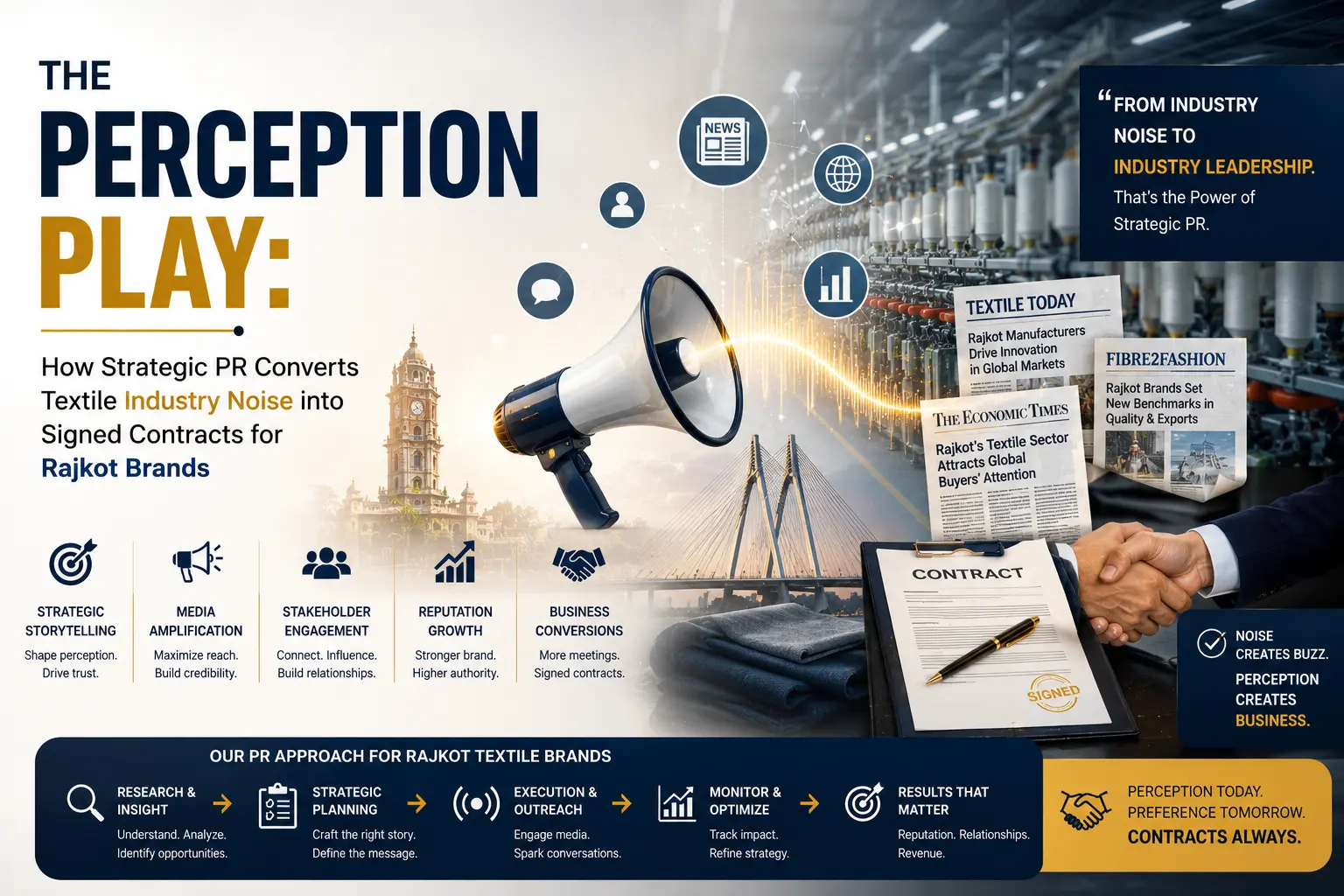
Walk any serious textile buyer through the decision they made before they made it.
Before the meeting. Before the price negotiation. Before the factory visit. There was a moment, quiet and rarely examined, where one supplier felt more credible than another. Where one brand name carried a weight that the other did not. Where the choice was already tilting in one direction before a single specification was compared.
That moment is where PR lives. And most Rajkot textile brands are leaving it entirely to chance.
The Noise Problem Is Real and Getting Louder
Rajkot’s textile and garment sector has never been short of players. The cluster runs deep: fabric manufacturers, processors, exporters, technical textile innovators, and everything in between. The buyer, whether they are sitting in a Mumbai sourcing office or a European import desk, is receiving more outreach, more samples, more capability decks than they have time to process.
In that environment, the supplier who gets heard is not necessarily the best one. It is the one that has already established credibility in the buyer’s mind before the outreach landed.
This is the noise problem. And the only thing that cuts through noise is not more noise. It is a different signal entirely.
Strategic PR is that signal. Not press releases. Not award entries. Not a company profile in a trade directory. The kind of PR that changes commercial outcomes is built on a specific architecture that most textile brands in Rajkot have not come close to deploying.
What Buyers Actually Trust (It Is Not What Most Brands Are Sending Them)
There is a research finding that surfaces consistently across B2B buying behaviour studies and that anyone who has been on the buying side of a textile procurement decision will recognise immediately.
Buyers trust third-party validation more than first-party claims by a ratio that is not even close.
What this means in practice: a capability deck that tells a buyer your quality is exceptional is infinitely less persuasive than a trade publication article that demonstrates it. A testimonial in your own brochure is a fraction as credible as an earned customer story published in an industry journal. Your social media post about your new machinery is background noise. A reporter’s piece about how your machinery investment is changing what is possible in Rajkot’s technical textile space is a signal that buyers forward to colleagues.
The asymmetry is not subtle. And yet the overwhelming majority of Rajkot textile brands are investing heavily in first-party claims, their own website, their own social media, their own sales decks, and almost nothing in the earned media and editorial credibility that actually moves the needle in procurement decisions.
Three Specific PR Plays That Convert in the Textile Sector
Generic PR advice is rarely useful for a sector as specific as textiles. What follows is a breakdown of the three approaches that are producing measurable commercial outcomes for textile brands operating at Rajkot’s level.
The Expertise Positioning Play
A Rajkot textile brand that publishes a bylined article in Textile Value Chain, the Fibre2Fashion network, or a relevant export-focused publication on a subject of genuine technical or market relevance is not just getting visibility. It is repositioning itself in the mind of every buyer who reads that piece.
The brand is no longer a supplier. It is a voice. And buyers do not just buy from suppliers. They build longer, deeper, more valuable relationships with voices they trust.
The content has to be genuine. Industry experts read industry publications. Thin promotional content in expert clothes gets seen through immediately and damages credibility rather than building it. The articles that work are the ones that say something true and specific that the reader could not easily have found elsewhere. An analysis of how a particular processing innovation is affecting fabric performance at scale. A perspective on where export demand is shifting and why. A technical examination of a durability challenge that buyers regularly face.
Writing this content is the easy part. Getting it placed in the right publications, framed in the right editorial voice, and distributed to the right media contacts is where strategic Media, PR and Celebrity Management earns its place.
The Milestone Story Play
Every significant business event is a PR opportunity that most Rajkot textile brands let expire without use.
A new machinery investment that increases production capacity. A certification achieved. A new export market entered. A sustainability initiative implemented. A generational leadership transition. A production milestone hit.
Each of these is a story. Not a story that a brand tells about itself, but a story that, properly pitched, a journalist will tell about the brand. The distinction matters enormously. The same information about a new production line reads very differently as a company press release and as a business correspondent’s profile piece in a Gujarat or national business publication.
What transforms a milestone into a media story is the angle. The machinery investment is not news by itself. The machinery investment that makes Rajkot’s textile cluster more competitive against imports, that signals investment confidence in the sector, that represents a specific kind of forward thinking that the publication’s readers would want to know about: that is a story.
Finding the angle is a craft. Executing the outreach with the relationship infrastructure to get it placed is a system. Both require investment in Media, PR and Celebrity Management that goes beyond sending press releases to a generic media list.
The Buyer Journey Intercept Play
This is the most sophisticated PR play available to Rajkot textile brands and the least commonly executed.
A procurement decision-maker doing due diligence on a potential textile supplier will, at some point, search. They will look up the company name. They will search the category and the geography. They will read whatever they find.
The question is: what do they find?
A brand that has been executing strategic PR for 12 to 18 months has built a searchable credibility trail. Industry articles carrying their name. Coverage in trade publications. Business media mentions. Interview appearances. Guest contributions. The buyer who searches finds a body of evidence that the brand is serious, credible, and recognised by sources the buyer trusts.
A brand that has not invested in this trail is either absent from search results or, worse, present only through its own promotional material, which, as established, is the least persuasive form of evidence available.
The buyer journey intercept play is simply the discipline of ensuring that wherever in the media landscape a due-diligence search leads, the searcher finds signals that build trust rather than silence or self-promotion.
This play connects Digital Marketing Services and PR directly: optimised content and earned media together build the searchable credibility architecture that intercepts buyers at the moment they are deciding.
The Textile Trade Show PR Multiplier
Rajkot’s textile brands participate in trade exhibitions. Many of them spend significant budget on the stand, the samples, the logistics, and the travel. Fewer of them treat the exhibition as a PR event.
The brands extracting maximum value from national and international textile exhibitions are treating them as media moments. Pre-event press outreach generates coverage before the show opens. On-floor media interviews with trade journalists create editorial content that reaches the much larger audience that never attended in person. Post-event thought leadership articles consolidate the positioning established on the floor.
An Events, Exhibitions and Activations strategy built with a media layer produces reach that multiplies the physical attendance figures by orders of magnitude.
The stand is the visible tip. The PR campaign around it is the mass beneath the surface.
When PR Meets the Physical Brand
There is one failure mode in textile PR that is worth naming explicitly.
A brand earns genuine editorial coverage. A buyer reads it. They are interested. They request a brochure, visit the website, or arrive at a meeting expecting the brand they read about.
And then the physical materials, the catalogue, the samples presentation, the meeting environment, feel like they belong to a different, lesser brand entirely.
This is the coherence failure that undoes PR investment. Earned credibility has a very short shelf life if the physical brand experience does not match the perception that the PR work created.
Print and Production and Integrated Marketing Communication are not separate workstreams from PR. They are the infrastructure that makes the PR investment hold. The editorial piece creates the expectation. Every subsequent physical touchpoint either confirms or collapses it.
Perception Is Not Soft. It Is Commercial Infrastructure.
The Rajkot textile brands that are winning national and export contracts in 2025 are not uniformly the ones with the best product. The correlation between product quality and contract value is weaker than most manufacturers want to believe.
The stronger correlation is between perceived credibility and contract value. Between the brand that has built a recognisable presence in the mind of its target buyer and the brand that is still relying on price and samples to do the entire job of persuasion.
PR is not a soft function. It is commercial infrastructure. It builds the perception layer that every other sales and marketing activity stands on.
A textile brand in Rajkot with a strong PR foundation sells on different terms than one without it. Shorter sales cycles. Less price sensitivity. More inbound than outbound. Relationships that renew rather than need to be rebuilt each season.
The investment required to build that foundation is smaller than most brands assume. The commercial return over a 24-month horizon is larger than most brands calculate for.
Build the Perception Your Brand Deserves
ONE Advertising’s Media, PR and Celebrity Management team works with textile brands across Rajkot and Gujarat to build earned media presence, editorial credibility, and the kind of third-party validation that converts due diligence into signed contracts.
We work within a fully integrated system that connects PR with digital, print, events, and film production, so that the perception PR creates is matched and reinforced at every touchpoint.
Start the conversation: https://oneadvt.com/connect/