


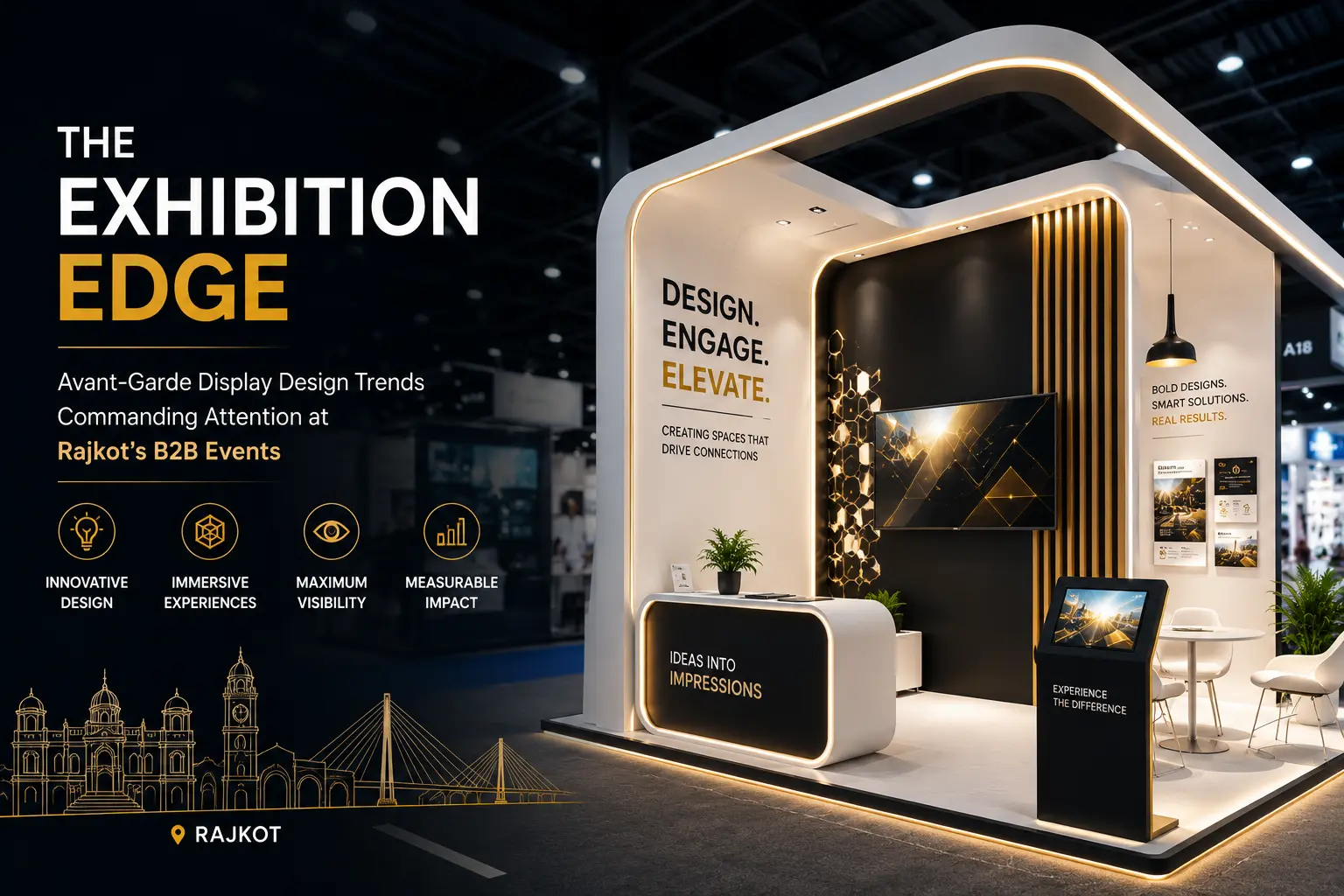
Most exhibition stands in Rajkot look like they were designed by committee.
Safe colours. Company logo centred at the top. A banner with six bullet points about the product range. A table with brochures that nobody picks up. Two staff members standing slightly too close to the aisle, making eye contact that feels just uncomfortable enough to make visitors cross to the other side.
Nobody planned for it to be forgettable. It just turned out that way, because forgettable is the default when design decisions are made to avoid mistakes rather than to create impact.
The brands changing this at Rajkot’s B2B events in 2026 are not spending dramatically more. They are thinking fundamentally differently about what an exhibition stand is actually for.
The Stand Is Not a Billboard. It Is a Stage.
This single reframe changes everything about how an exhibition presence gets designed.
A billboard is a surface that communicates information to a passing audience. A stage is an environment that pulls an audience in, holds their attention, and creates an experience they carry with them after they leave.
Most exhibition stands in Gujarat are designed as billboards. They display. They do not draw in. They inform. They do not engage. They present the brand as a static object rather than an active presence.
The avant-garde shift happening at B2B events across Rajkot and Gujarat is away from “how do we show our product” and toward “how do we make someone want to step inside and stay.”
That shift has spatial implications, sensory implications, and staffing implications that most brands have not started thinking about yet.
What Is Actually Working on the Exhibition Floor Right Now
The Negative Space Stand
The crowded exhibition floor is a visual cacophony. Every stand competing with its neighbour for attention through size, brightness, and volume. The counter-intuitive response that is earning extraordinary results for certain Rajkot brands is radical restraint.
A stand designed around negative space, with one dominant visual element, a single material story, and deliberate absence of clutter, reads as confident in an environment where everything else is shouting. It signals that the brand does not need to prove itself through volume. The psychological effect on a senior buyer walking the floor is significant. Restraint reads as authority.
This does not mean cheap. It means intentional. The materials used in a restrained stand are typically higher quality, because they are the only things being looked at.
Immersive Material and Texture
For Rajkot’s industrial and manufacturing exhibitors especially, the shift toward tactile exhibition design is creating genuine differentiation.
A ceramics manufacturer whose stand allows visitors to handle product samples displayed as considered objects rather than stacked inventory is communicating quality through the nervous system, not through a specification sheet. An engineering company whose stand incorporates the actual materials they work with as architectural elements is making the product the environment.
Touch, texture, and material weight communicate premium positioning faster and more durably than any graphic can. The body knows quality before the brain has time to evaluate it.
The Demonstration Environment Over the Display Stand
The most-visited stands at Rajkot’s B2B exhibitions in 2025 are consistently the ones where something is happening.
A working process demonstration. A live customisation experience. A before-and-after installation showing a transformation. An expert consultation happening visibly in an open format that other visitors can observe and then feel compelled to join.
Static stands ask visitors to process information. Demonstration environments invite visitors to witness something. The neurological difference in attention and recall between these two experiences is not marginal. It is the difference between a brochure that gets glanced at and a conversation that gets remembered at the purchasing meeting three weeks later.
Lighting as Architecture
This is one of the most underinvested elements in Rajkot’s B2B exhibition design, and one of the highest-return upgrades available.
Exhibition halls are lit for utility. Flat, even, functional light that makes everything look equally important, which means nothing looks particularly important. Brands that invest in exhibition-specific lighting design, directional spotlights, colour-temperature management, backlit graphic panels with considered intensity, are creating a visual hierarchy that guides the visitor’s eye without them realising it is happening.
A well-lit stand in a poorly-lit exhibition hall does not just look better. It looks like a different category of brand entirely.
Spatial Storytelling Over Information Architecture
The traditional exhibition stand organises information. It has a product section, a company history section, an awards and certifications section. It is logical. It is also how you lose someone’s attention in 90 seconds.
Spatial storytelling organises the visitor’s experience instead. You enter the stand and immediately encounter the problem your brand solves, not a logo. You move through the space and the narrative unfolds rather than being presented all at once. You leave having been on a brief journey rather than having received a briefing.
This approach borrows from retail design, museum curation, and hospitality, industries that have spent decades figuring out how to hold physical attention. B2B exhibition design is only beginning to absorb these lessons.
The Staff Question Nobody Wants to Answer
Exhibition stands are often evaluated on design and overlooked on the single variable that most determines their commercial success: the people inside them.
A brilliant stand staffed by team members who are not trained for the exhibition context will underperform a mediocre stand staffed by people who know exactly how to open a conversation, qualify a visitor in under two minutes, and move the interaction toward a next step.
The brands commanding attention at Rajkot’s B2B events in 2025 are treating their exhibition staff as part of the design brief, not an afterthought. Stand layout is planned around how a conversation naturally flows. Traffic routing through the space is designed to create natural moments for a staff member to step in without it feeling forced. The opening line is not left to individual improvisation.
This is where Events, Exhibitions and Activations planning that goes beyond spatial design into experiential logic becomes the difference between a stand that generates contacts and a stand that generates conversations that close.
Before the Event and After It: Where Most Brands Leave Value on the Floor
The exhibition stand is the most visible part of a B2B event strategy. It is not, however, where the most commercial value is created or lost.
The brands extracting maximum return from Rajkot’s B2B exhibitions are treating the event as a campaign with three distinct phases, not a standalone moment.
Before the event, they are using Digital Marketing Services to create anticipation among existing contacts and target prospects. An email sequence announcing their presence. A LinkedIn campaign targeting industry buyers registered for the event. A WhatsApp broadcast to their warm lead list. The goal is to arrive at the exhibition with meetings already confirmed rather than relying entirely on floor traffic.
During the event, content capture is happening in real time. Video of live demonstrations. Photography of the stand at capacity. Testimonials filmed on the floor. This content feeds the Media, PR and Celebrity Management cycle immediately, creating coverage that extends the event’s reach to people who were not in the room.
After the event, the follow-up is structured rather than sporadic. Every contact made is assigned a specific next action within 48 hours. The Print and Production leave-behinds handed out at the stand are designed to be kept rather than discarded, because they are genuinely useful objects rather than generic brochures.
The exhibition stand is the spike. The campaign around it is what converts the spike into lasting commercial momentum.
The Coherence Test
There is one question worth asking before any exhibition design brief gets signed off.
If someone who has never heard of your brand walks into your stand with no prior context, does the experience tell them, within 30 seconds, who you are, what you do, who you do it for, and why you are different?
Not through text. Through the space itself. Through the materials, the light, the layout, the presence of your team, and the single most dominant visual element they encounter on entry.
If the answer is no, the stand is doing less work than it should. And in a room full of competitors all fighting for the same 45 seconds of a senior buyer’s attention, a stand that cannot pass the 30-second coherence test is effectively invisible.
Integrated Marketing Communication applied to exhibition design means the stand brief starts with brand strategy, not with a floor plan. The spatial design is a three-dimensional expression of a positioning that already exists, not an independent creative exercise.
When the stand is coherent with every other touchpoint a buyer might have encountered, the recognition it earns is compounded. They have seen your brand before. They just have not seen it like this.
Design the Stand Your Brand Actually Deserves
ONE Advertising’s Events, Exhibitions and Activations team works with brands across Rajkot and Gujarat to design exhibition presences that are strategically grounded, spatially considered, and built to generate commercial outcomes before, during, and after the event.
Start the brief: https://oneadvt.com/connect/
The next exhibition is either an opportunity or an expense. Which one it becomes is a design decision.