


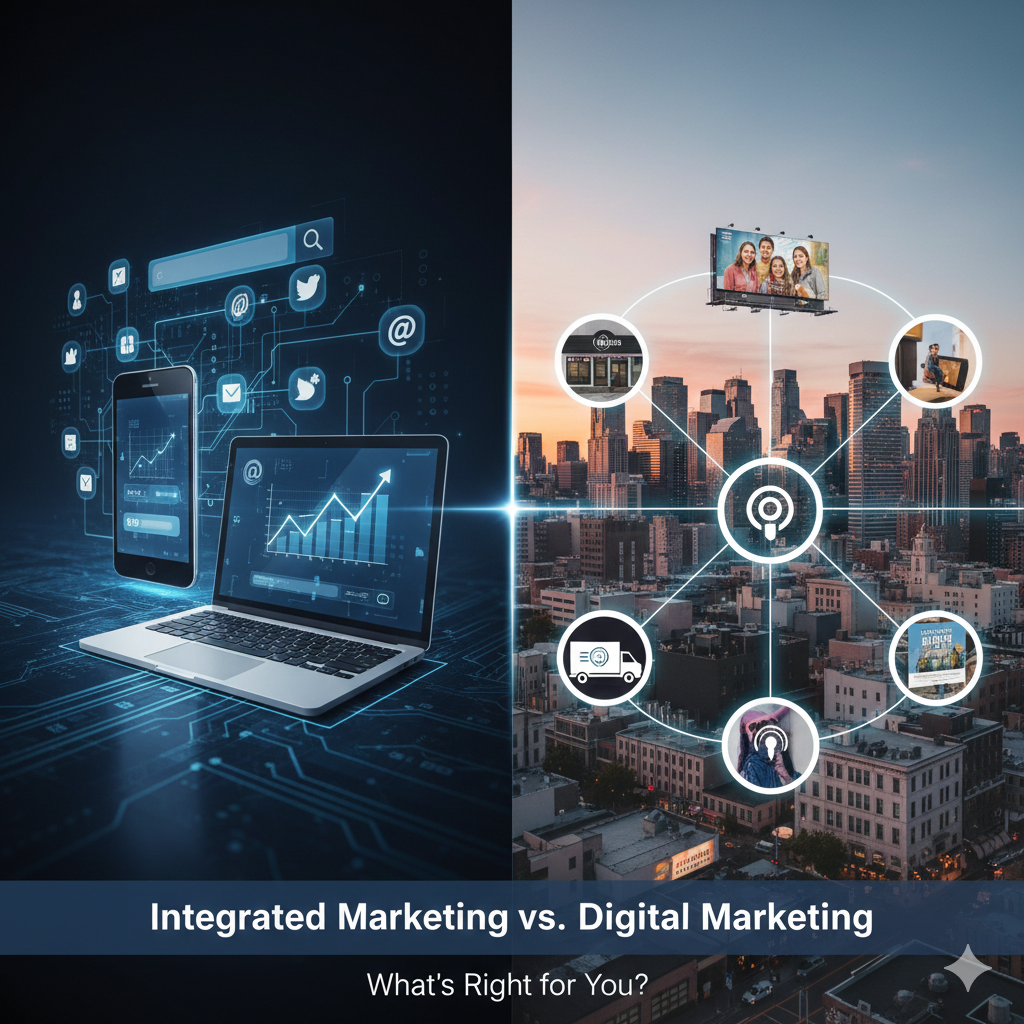
Marketing today is no longer about choosing a single channel or running isolated campaigns. Consumers move fluidly between online and offline worlds—discovering brands on social media, researching on Google, encountering them through outdoor ads, and finally converting via a website or store visit. In this environment, businesses often face a critical question:
Should we invest in Digital Marketing or adopt a fully Integrated Marketing approach?
While these two strategies are interconnected, they serve different purposes depending on business maturity, audience behavior, and growth objectives. Understanding the difference in depth can help you avoid fragmented efforts and build a marketing system that delivers both short-term results and long-term brand equity.
Understanding Digital Marketing in Depth
Digital marketing refers to all marketing activities executed through online channels. It is performance-oriented, data-driven, and optimized for speed, scalability, and measurability.
Core Components of Digital Marketing
- Search Engine Optimization (SEO)
Improves organic visibility on search engines by targeting keywords, content quality, technical performance, and user intent. - Paid Advertising (PPC & Display Ads)
Includes Google Ads, YouTube ads, and programmatic display campaigns designed to generate traffic, leads, or sales quickly. - Social Media Marketing
Combines organic content and paid promotions on platforms like Instagram, Facebook, LinkedIn, and X to drive engagement and conversions. - Content Marketing
Blogs, videos, landing pages, and lead magnets that educate, inform, and nurture audiences across the funnel. - Email & Automation
Personalized communication used for retention, upselling, and lifecycle marketing.
Strengths of Digital Marketing
- Highly measurable ROI
- Real-time optimization
- Budget flexibility
- Precise audience targeting
- Faster go-to-market execution
Digital marketing excels when the objective is immediate visibility, lead generation, or online sales.
Limitations of Digital Marketing
- Brand recall may be limited without offline reinforcement
- Messaging can become inconsistent across platforms
- Over-reliance on performance metrics can weaken brand storytelling
- Competitive ad environments increase cost over time
Digital marketing works best when supported by a strong brand foundation.
Understanding Integrated Marketing in Depth
Integrated marketing is a holistic strategy that aligns all marketing channels—digital and offline—under a single brand narrative and strategic direction.
Instead of asking “Which channel should we use?”, integrated marketing asks:
“How does the brand experience feel at every touchpoint?”
Channels Involved in Integrated Marketing
- Digital marketing (SEO, paid ads, social media, content)
- Branding and visual identity
- Print media (newspapers, brochures, magazines)
- Outdoor advertising (hoardings, transit ads)
- Events, activations, and experiential marketing
- PR and influencer outreach
- In-store or on-ground brand presence
Core Principle: Consistency
Integrated marketing ensures that:
- The brand looks the same everywhere
- The message feels connected across platforms
- Customers recognize and trust the brand faster
This consistency significantly strengthens brand recall and emotional connection.
Strategic Differences Between Digital and Integrated Marketing
1. Campaign vs. Ecosystem Thinking
- Digital Marketing: Focuses on individual campaigns and KPIs
- Integrated Marketing: Builds a long-term brand ecosystem
Digital marketing answers “Did this campaign convert?”
Integrated marketing answers “How does this campaign fit into the brand journey?”
2. Short-Term Performance vs. Long-Term Equity
- Digital marketing is optimized for immediate outcomes
- Integrated marketing balances performance and brand equity
Brands that rely only on digital ads may see diminishing returns over time. Integrated marketing ensures sustained growth by strengthening trust and familiarity.
3. Audience Touchpoints
- Digital marketing interacts mainly with online audiences
- Integrated marketing covers online discovery + offline experience
This is especially critical in markets where purchasing decisions are influenced by physical presence, reputation, and visibility.
4. Organizational Impact
- Digital marketing can function in silos
- Integrated marketing requires cross-team alignment
Integrated marketing aligns leadership, sales, marketing, and customer experience around one unified vision.
Which Strategy Fits Your Business Stage?
Early-Stage Businesses & Startups
Best fit: Digital Marketing
Why:
- Limited budgets
- Need for quick traction
- Focus on validation and leads
Digital marketing allows startups to test messaging, audiences, and offers with minimal risk.
Growing Businesses & Regional Brands
Best fit: Hybrid (Digital + Select Offline)
Why:
- Expanding customer base
- Need for stronger credibility
- Increasing competition
At this stage, digital marketing is reinforced with brand-led communication to improve recall and trust.
Established Brands & Market Leaders
Best fit: Integrated Marketing
Why:
- Multiple customer touchpoints
- Strong competition for attention
- Need for consistent brand authority
Integrated marketing ensures that the brand remains recognizable, trusted, and relevant across every interaction.
Budget Perspective: Cost vs. Value
A common misconception is that integrated marketing is “expensive.” In reality, it’s about value creation, not just cost.
- Digital marketing optimizes cost per lead or sale
- Integrated marketing optimizes lifetime brand value
Brands investing only in digital marketing may spend less initially but more over time due to rising ad costs and low brand loyalty. Integrated marketing reduces long-term acquisition costs by strengthening brand pull.
The Role of Data in Both Approaches
Digital marketing is deeply data-driven, using:
- Clicks
- Impressions
- Conversions
- Cost metrics
Integrated marketing also uses data—but interprets it differently:
- Brand recall studies
- Engagement quality
- Customer sentiment
- Long-term growth patterns
The most effective strategies combine quantitative performance data with qualitative brand insights.
Why the Future Belongs to Integrated Marketing
Consumer journeys are no longer linear. A person may:
- See a social media ad
- Research on Google
- Notice a billboard
- Hear about the brand from peers
- Finally convert weeks later
Without integration, these touchpoints feel disconnected. Integrated marketing turns them into one coherent story.
As markets become more competitive, brands that win are those that:
- Communicate clearly
- Stay consistent
- Build emotional trust
- Deliver value beyond ads
Final Decision Framework
Ask yourself:
- Are we building short-term sales or long-term brand value?
- Do our customers interact with us online, offline, or both?
- Is our messaging consistent across channels?
- Are we optimizing only for conversions—or also for trust?
If your focus is speed and performance, digital marketing is the right starting point.
If your focus is scale, credibility, and longevity, integrated marketing is the destination.
Conclusion
Digital marketing and integrated marketing are not rivals—they are stages of evolution.
Digital marketing helps brands enter the market, gain visibility, and generate results. Integrated marketing helps brands stay relevant, trusted, and impactful over time.
The most successful brands don’t ask “Which one should we choose?”
They ask “How do we integrate digital performance into a unified brand experience?”
That is where real, sustainable growth begins.