


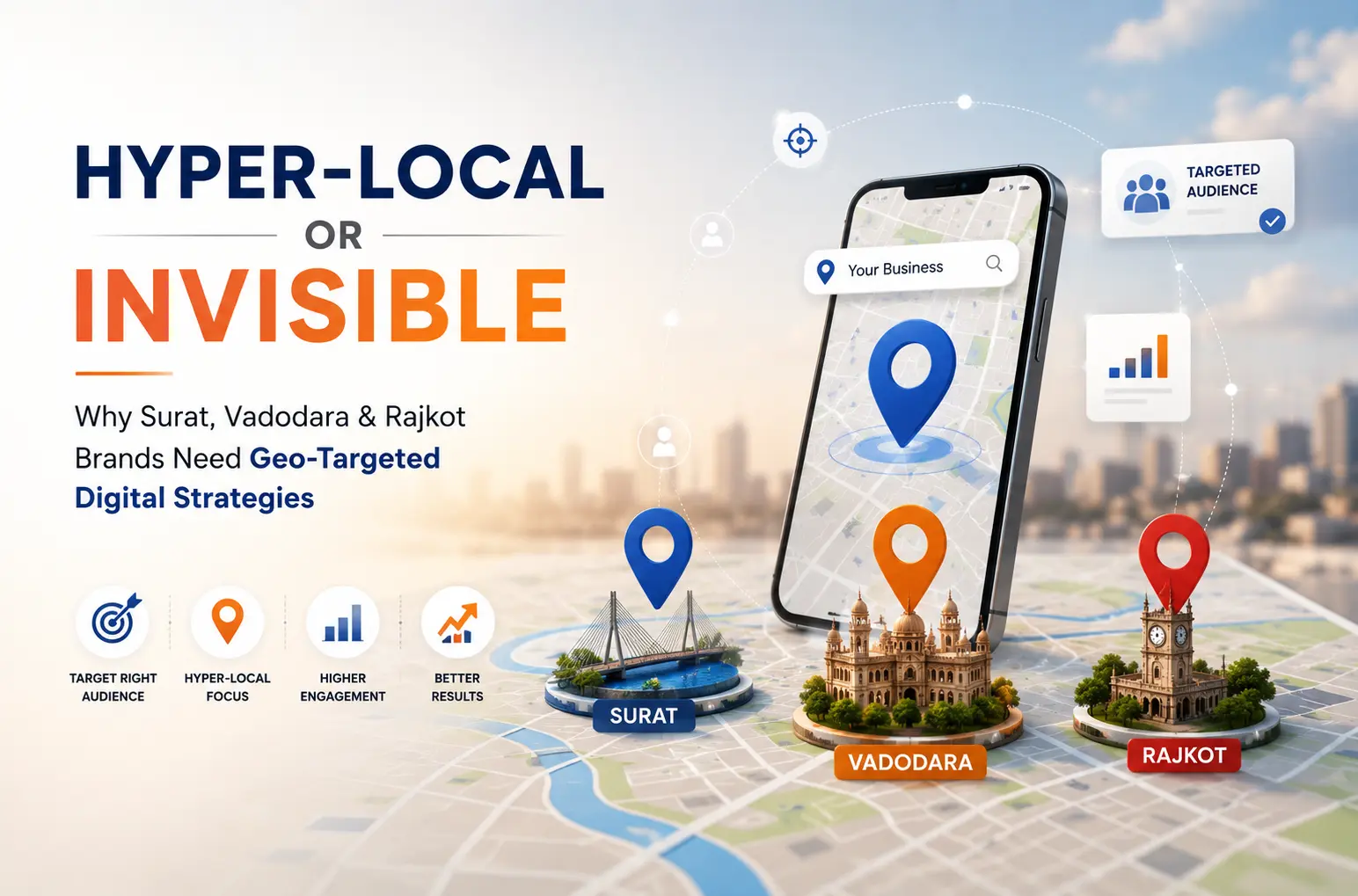
Something strange happens when a Surat textile brand runs the same digital campaign as a Rajkot manufacturer.
They both spend. They both get impressions. And neither of them can quite explain why the results feel underwhelming relative to the budget.
The answer is almost always the same. The campaign was built for everyone in Gujarat, which in practice means it was built for no one in particular. And in a digital environment where relevance is the single biggest driver of performance, “no one in particular” is a losing strategy.
Three Cities. Three Completely Different Markets.
This is the starting point that most digital campaigns skip entirely, and it costs brands dearly.
Surat, Vadodara, and Rajkot are not interchangeable versions of the same Gujarati consumer. They are distinct commercial ecosystems with different dominant industries, different buyer psychologies, different media habits, and different cultural reference points that determine what communication lands and what gets scrolled past.
Surat is India’s diamond and textile capital. The dominant buyer in Surat is trade-oriented, fast-moving, and accustomed to volume. Price sensitivity is sophisticated here, not unsophisticated. The Surat consumer does not just want value; they can calculate it precisely and will compare three options before making a call. B2B relationships in Surat move at a pace that requires digital touchpoints to be efficient and credibility signals to be immediate. A campaign that works in a slower commercial culture will feel sluggish here.
Vadodara carries a different character entirely. It is a city with institutional depth: Maharaja Sayajirao University, established manufacturing corridors, and a professional class with considerable education and purchasing power. The Vadodara buyer responds to quality narratives, heritage, and category expertise. This is a market where brand story matters, where the “why” behind a business earns attention in a way it might not in a purely transactional environment. Digital campaigns that skip the story and lead with the offer frequently underperform here.
Rajkot sits at the intersection of industrial pragmatism and community commerce. It is a city where relationships are currency, where the local trust signal of being “from Rajkot” or being recommended by someone in the community carries real weight in purchase decisions. Digital campaigns that feel imported or generic are quietly rejected, not with criticism but with indifference. The campaigns that work in Rajkot feel like they understand the city, because they were built by people who do.
Run one campaign across all three and you have built a message calibrated for none of them.
What Geo-Targeting Actually Means in Practice
The term gets used loosely, so it is worth being precise.
Geo-targeting at its most basic level means restricting your ad delivery to a specific geographic area. Showing a Facebook ad only to users within Surat city limits. Running a Google search campaign that only activates when someone in Vadodara searches your category. This is table stakes. Most businesses doing any kind of paid digital marketing are already doing this at a rudimentary level.
Hyper-local geo-targeting is different in kind, not just degree.
It means understanding which neighbourhoods within Surat have the highest concentration of your target buyer and weighting your ad spend toward those pin codes. It means recognising that the search behaviour of a Rajkot consumer looking for commercial interior design is different in phrasing, intent, and timing from a Vadodara consumer searching for the same thing, and writing different ad copy for each. It means using location data to deliver different creative to different city audiences within the same campaign, so that a resident of Varachha in Surat sees a reference that feels local while a resident of Alkapuri in Vadodara sees something calibrated to their context.
It means, most practically, treating geography as a strategic variable rather than a targeting filter.
The Budget Leak That No One Talks About
Here is a number worth thinking about.
A mid-sized brand running digital campaigns across Gujarat without geo-specific optimisation is typically losing somewhere between 30 and 50 percent of their budget to audiences that will never convert, either because the geographic targeting is too broad, the creative does not resonate with the specific city audience, or both.
That is not a margin issue. That is a strategy issue.
Digital Marketing Services built around hyper-local logic do not just reduce wasted spend. They change the fundamental economics of a campaign. When your creative is calibrated to a specific audience in a specific city, the click-through rate improves. When the landing experience matches what the local buyer expects, conversion improves. When you are only paying to reach people who are genuinely proximate to a purchase, cost per lead drops.
The campaign that reaches 10,000 people in the right city, with the right message, at the right moment, will consistently outperform the campaign reaching 100,000 people across Gujarat with a message that is correct for none of them.
The Language Layer Most Brands Get Wrong
Gujarat is a Gujarati-speaking state. This is not an observation, it is a creative brief.
Brands running purely English or Hindi digital campaigns in Surat, Vadodara, and Rajkot are making an assumption about their audience that the data does not support. Gujarati-language content consistently outperforms translated alternatives in engagement and recall across all three cities, particularly in categories where the buyer is making a considered purchase and wants to feel that the brand is speaking to them, not at them.
This extends beyond language into idiom, cultural reference, seasonal timing, and festival sensitivity. A campaign that acknowledges Uttarayan in a way that feels genuinely local rather than performatively festive earns a different kind of attention. A brand that uses a regional reference point that resonates in Saurashtra creates instant recognition in Rajkot that a generic Gujarati reference cannot replicate.
The Integrated Marketing Communication layer is where this localisation strategy gets built, ensuring that the city-specific creative decisions are not just executional variations but are grounded in a coherent brand position that holds across all three markets while feeling native to each.
Offline and Online: The Geo-Targeting Gap Nobody Fixes
There is an irony that runs through most discussions of geo-targeted digital strategy.
Brands invest considerably in getting their digital geo-targeting right. They know which pin codes to target, which platforms their city audience uses, which hours see the highest conversion rates. And then they run Print and Production materials and outdoor activity that is entirely city-agnostic, collateral that says the same thing in Surat as it says in Rajkot, which undermines the precision of the digital work by creating a disconnected brand experience.
Hyper-local strategy only delivers its full value when the digital and physical touchpoints are aligned. The billboard on Rajkot’s Kalawad Road should carry the same message, tone, and visual language as the Instagram ad running to Rajkot users that week. The exhibition display at a Vadodara trade show should reflect the same positioning as the Google search campaign running in Vadodara simultaneously.
Events, Exhibitions and Activations planned with city-specific intelligence, and Media, PR and Celebrity Management targeted to local publication and broadcast audiences in each city, complete the picture. This is what turns geo-targeting from a digital media tactic into a genuine market penetration strategy.
The Visibility Equation in Competitive City Markets
Surat, Vadodara, and Rajkot are not low-competition markets. Each city has a growing base of businesses that have figured out that digital presence matters and are investing accordingly.
In that environment, the brand that wins is not necessarily the one with the largest budget. It is the brand that is most relevant to the specific person seeing their ad at the specific moment they see it. Relevance is the product of knowing your audience precisely, and you cannot know your audience precisely if you are treating three distinct cities as one undifferentiated Gujarat market.
Hyper-local or invisible is not an exaggeration. In competitive city-level digital environments, a campaign that is calibrated for everyone is effectively invisible to anyone whose attention you actually need.
The brands that treat Surat like Surat, Vadodara like Vadodara, and Rajkot like Rajkot, in their creative, their media placement, their language, and their cultural references, are the ones building the kind of local authority that no budget-heavy generic campaign can buy its way into.
This Is a Solvable Problem
The good news is that hyper-local geo-targeting is not a technology challenge. The tools exist. Google, Meta, and programmatic platforms all have the geographic precision required to execute city-level and neighbourhood-level campaigns.
The challenge is strategic and creative: understanding each city deeply enough to build campaigns that earn local relevance, and having the production capability to execute those campaigns at the quality level that the audience expects.
Both of those capabilities exist at ONE Advertising.
Build a Strategy That Knows Where It Is
ONE Advertising works with brands across Surat, Vadodara, Rajkot, and wider Gujarat to engineer geo-targeted campaigns that feel native to each market and deliver measurable performance in each city.
Whether you are starting fresh or auditing why your current campaigns are underperforming across cities, the conversation starts here.
Connect with our team: https://oneadvt.com/connect/