


There is a particular kind of frustration that visits successful regional businesses.
The product is genuinely good. The operations are running well. The reputation in the home market is solid. Customers refer to others. The team has grown. Revenue is at a level that most people would consider a success.
And yet the national market feels like a wall rather than a door.
Other brands from other cities seem to make that leap. Theirs do not. The question that hangs in the air at strategy meetings, though it is rarely asked this directly, is: what do they have that we do not?
The honest answer, in most cases, is not a better product. It is a better brand.
What Regional Actually Means (And Why It Is Not About Geography)
Here is the uncomfortable truth that most regional brand conversations avoid.
Being a regional player is not a function of where your offices are or which cities your customers currently come from. It is a function of how your brand is perceived by people who do not already know you.
A business can have customers in Mumbai, Delhi, and Bangalore and still be a regional brand in the way that matters most, because every new market encounter requires them to start from scratch, to explain who they are, to overcome unfamiliarity, to build trust from zero. There is no brand equity doing advance work for them.
A genuinely national brand enters a room with a reputation that precedes it. Buyers already have a frame of reference. The trust-building conversation starts further along. The sales cycle is shorter. The pricing conversation is different.
The gap between a regional player and a national contender is almost entirely a brand equity gap. And brand equity is built, not inherited.
The Anatomy of a Rajkot Brand That Made the Leap
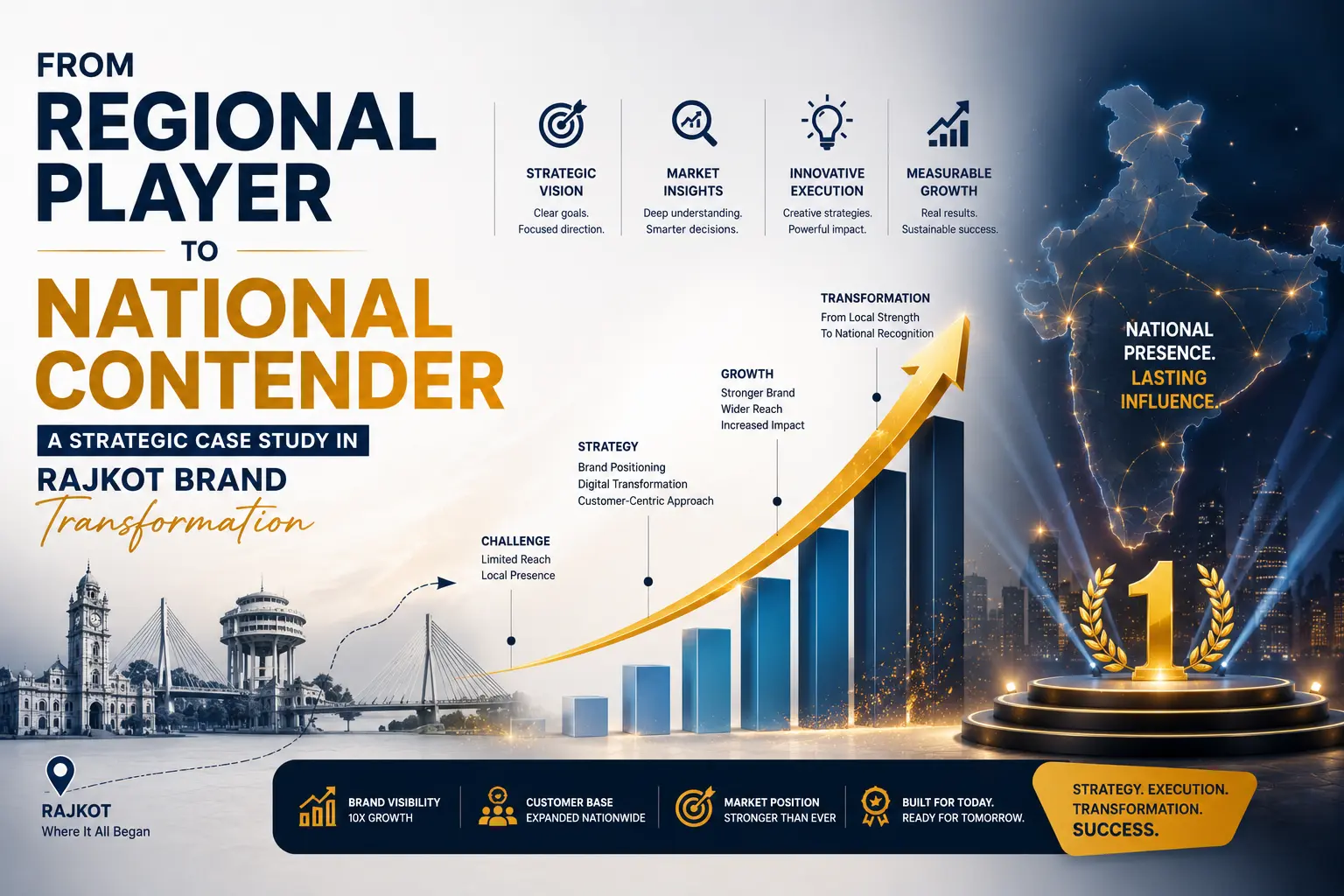
This is a composite portrait drawn from the pattern that repeats itself across the Rajkot businesses that have successfully expanded into national markets. It is not one company. It is the shape of a transformation.
Year One: They stopped explaining and started positioning.
The first and most important shift was moving from descriptive communication to positioning communication. The business had been telling the market what it did: manufactured X product to Y specification at Z price. Accurate. Forgettable.
Positioning communication answers a different question: why does this brand exist, and what does it stand for in a world with other options?
For a Rajkot manufacturer, this often means articulating a point of view about quality, about the craft behind the product, about what the business refuses to compromise on. It means having an opinion, which is different from having a feature list.
The positioning work happened first, internally, before a single external campaign launched. Every subsequent communication decision was evaluated against it: does this reinforce our position or dilute it?
The creative infrastructure came next.
A business cannot take a strong position to a national market without the creative infrastructure to express it consistently.
This meant a Film Production investment in a brand film that could anchor the national narrative. Not a product video. A brand film: the story of why this Rajkot business exists, told with the production quality that national buyers expect and the cultural authenticity that only comes from a production team that understands the Saurashtra context from the inside.
It meant Print and Production materials rebuilt from the ground up, not updated versions of the old brochure but a complete rethinking of how the brand presents itself on paper, at a quality level that does not apologise for coming from Rajkot.
It meant a digital presence rebuilt around the positioning, not around the product catalogue.
Then the market-facing strategy deployed.
With the foundation set, the expansion strategy could actually work.
Digital Marketing Services targeting national industry buyers in priority cities. Not the same campaign that ran in Rajkot scaled up, but city-specific campaigns calibrated to each target market’s buying culture, the language of Mumbai’s fast-moving commercial sector, the quality-narrative register that works in Delhi’s corporate procurement environment.
Media, PR and Celebrity Management placed editorial features in national trade publications and business media. Not advertorials. Earned coverage, built on a media narrative that was genuinely interesting because the brand had a story worth telling. The positioning work done in Year One was what made the PR work possible. Without a point of view, there is no story for a journalist to tell.
Events, Exhibitions and Activations at national trade shows were redesigned around the new brand position. The stand no longer looked like it came from a regional manufacturer trying to look national. It looked like a brand that had always known what it stood for and was simply now introducing itself to a wider audience.
The integration was the strategy.
None of these elements worked because of their individual quality alone. They worked because they were coordinated by Integrated Marketing Communication planning that ensured every touchpoint reinforced the same core message.
A national buyer in Mumbai encountered the brand first through a LinkedIn article. Then through a trade publication feature. Then through a remarketing ad that referenced the same brand narrative. Then at a national exhibition where the stand expressed the same positioning physically. By the time a sales conversation happened, the trust-building work was already largely done.
This is what integration actually means in commercial terms. Not consistent fonts and colours. Coordinated brand encounters that compound into recognisable, trustworthy presence.
The Mistakes That Keep Rajkot Brands Regional
The transformation pattern above is clear in retrospect. What is equally instructive is the pattern of decisions that prevent it from happening.
Mistaking visibility for positioning. Running more ads is not the same as building a brand. A Rajkot business that increases its digital spend without first clarifying its position simply reaches more people with a message that does not distinguish it from any other option. Spending without positioning is amplified noise.
Treating national expansion as a geographic exercise. Opening a sales office in Mumbai or listing on a national e-commerce platform does not make a brand national. Distribution is not positioning. The businesses that enter national markets through distribution alone consistently find that the market does not know what to do with them, because there is no brand context to help buyers understand why they should choose this brand over a more familiar alternative.
Waiting until the product is perfect. This is the most understandable mistake and one of the most expensive. The product is already good enough. The brands that are gaining national ground right now are not necessarily better products. They are better positioned, better communicated, and better distributed across touchpoints. Waiting for product perfection while competitors build brand equity is a trade that rarely ends well.
Underinvesting in creative quality. A brand that presents itself at national level with the creative standards of a regional player signals, immediately and unconsciously, that it is a regional player. National buyers, whether in B2B or B2C categories, make rapid trust assessments based on the quality of every brand material they encounter. A low-quality brochure, a poorly produced video, an inconsistent digital presence: each one creates doubt that the brand then has to work twice as hard to overcome.
The Question Worth Asking Right Now
The Rajkot businesses reading this that are genuinely capable of national expansion are not being held back by their product, their operations, or their market.
They are being held back by a brand that has not yet been built to carry the weight of national ambition.
The gap is closeable. It has a specific shape: positioning work, creative infrastructure, integrated communication strategy, and the discipline to execute consistently across markets and time. None of that is mysterious. All of it is achievable.
The relevant question is not whether national expansion is possible. For many Rajkot businesses, it demonstrably is. The question is whether the brand work gets done now, while the window is open, or later, when more competitors from more cities have already moved through it.
Ready to Build a Brand That Can Go National?
ONE Advertising works with businesses across Rajkot and Gujarat at exactly this inflection point, when a strong regional operation is ready to become something larger and needs the brand infrastructure to get there.
Positioning strategy. Creative production. Integrated communication. Media and PR. Digital expansion. We build the complete system.
Start the conversation: https://oneadvt.com/connect/